Compliance Disclaimer: The content of this article is provided for informational and educational purposes only. It does not constitute an offer to sell or a solicitation of an offer to buy any securities or investment products. Any offering of interests in Savanti-sponsored private investment funds is made solely to eligible U.S. accredited investors pursuant to definitive offering documents under SEC Regulation D, Rule 506(c). No performance claims are made herein. Past performance is not indicative of future results. Investing in private funds involves substantial risks, including the risk of complete loss of capital. Please consult a licensed financial advisor before making any investment decisions.
The Architecture of Modern Alpha
The hedge fund industry crossed a structural threshold in 2025. For the first time in over a decade, the sector delivered back-to-back years of double-digit returns—averaging 11.2% across strategies—while simultaneously crossing $5 trillion in assets under management. Behind this milestone is not a single macro tailwind or a lucky sector bet. It is the systematic deployment of artificial intelligence at every layer of the investment stack.
By April 2026, over 70% of global hedge funds have embedded machine learning models directly into their trading pipelines. More telling: approximately 18% of funds now rely on AI for more than half of their signal generation. This is not incremental adoption—it is a structural transformation of how institutional capital is deployed.
This article examines the technical architecture driving this transformation: how multi-agent AI systems generate signals, how generative AI is reshaping risk management, and why the convergence of discretionary and quantitative approaches is producing a new class of investment platform.
Signal Generation: From Single Models to Multi-Agent Ecosystems
The first generation of quantitative AI in finance relied on single, monolithic models—a neural network trained on price history, a regression model on factor exposures. These approaches, while powerful, were brittle. They failed to capture the multi-dimensional, non-stationary nature of financial markets.
The current generation is fundamentally different. Leading funds are deploying multi-agent AI systems—collaborative ecosystems of specialized AI agents, each with a defined role, that collectively produce more robust and nuanced investment signals.
A typical architecture might include:
– Sentiment Analysis Agents: Processing real-time news feeds, earnings call transcripts, and social media data using Large Language Models (LLMs) to generate sentiment scores at the security and sector level.
– Quantitative Signal Agents: Applying mathematical models—momentum, mean-reversion, factor exposures—to structured market data.
– Alternative Data Agents: Ingesting satellite imagery, credit card transaction data, web traffic patterns, and geolocation signals to identify leading indicators of corporate performance.
– Orchestrator Agents: Synthesizing outputs from specialized agents using a “decomposition-and-dispatch” architecture, weighting signals by confidence and regime context.
Frameworks like TauricResearch’s open-source “TradingAgents” have demonstrated that LLM-based agent crews can outperform single-model approaches by incorporating diverse information sources and enabling dynamic role specialization. The key insight is that financial markets are too complex for any single model to capture—but a well-designed ensemble of specialized agents can approximate the breadth of a human research team at machine speed.
Generative AI in Risk Management: Beyond Static Stress Tests
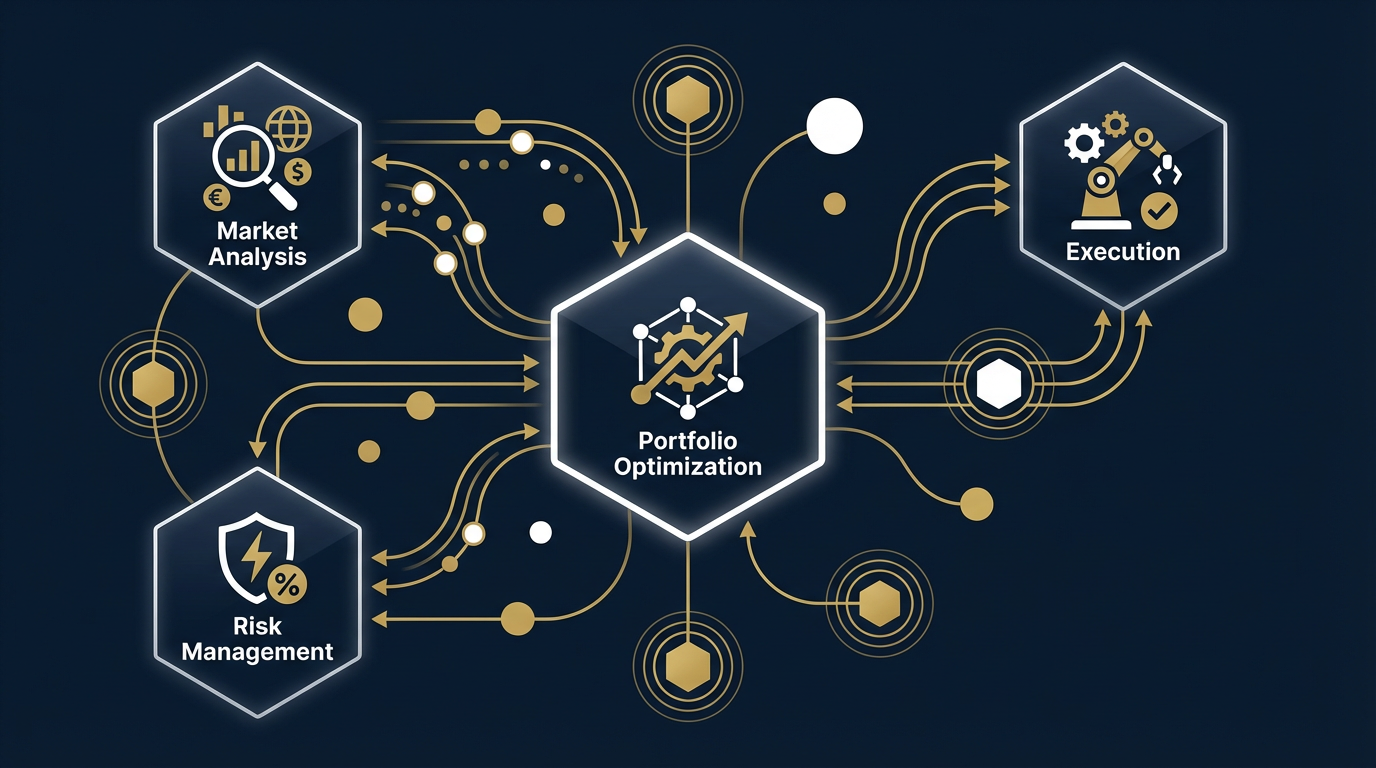
Traditional risk management relied on historical covariance matrices and scenario analysis based on past market shocks. These approaches have a fundamental limitation: they cannot anticipate unprecedented events. The 2020 COVID shock, the 2022 rate cycle, the 2025 geopolitical volatility—none were well-captured by backward-looking models.
Generative AI is changing this. Modern risk platforms use generative models to:
- Synthesize novel stress scenarios by combining historical patterns with current macro conditions, generating plausible but unprecedented market environments for portfolio stress testing.
- Detect anomalies in real time by learning the statistical fingerprint of normal market behavior and flagging deviations that may indicate regime change or liquidity stress.
- Dynamically adjust position sizing based on real-time risk assessments, moving beyond static stop-loss rules to adaptive risk controls that respond to changing market microstructure.
The integration of AI into risk management is not merely about speed—it is about the ability to model complexity that exceeds human cognitive capacity. A portfolio of 500 securities with cross-asset correlations, options exposures, and macro factor sensitivities creates a risk surface that no human team can monitor continuously. AI systems can.
The Quantamental Convergence
The traditional divide between discretionary and quantitative investing is eroding. The industry is converging on a hybrid model—often called “quantamental” investing—that combines the contextual judgment of human portfolio managers with the scale and speed of machine-driven analysis.
This convergence is visible at the largest funds. Point72 Asset Management uses NLP to analyze earnings calls and news sentiment, feeding data-driven insights to its discretionary portfolio managers. Citadel and Millennium have built proprietary data infrastructure that allows their discretionary teams to access quantitative signals in real time. Conversely, pure quant funds are incorporating macro-level thematic inputs to make their models more robust to policy shocks and regime changes.
The result is a new investment paradigm where AI is not a replacement for human judgment but an amplifier of it. Human managers provide the contextual understanding, the ability to reason about unprecedented events, and the accountability that institutional investors require. AI provides the scale, speed, and data-processing capacity that no human team can match.
The Challenges: Data Quality, Overfitting, and the Black Box
The deployment of AI in finance is not without significant technical and governance challenges.
Data Quality and Bias: The effectiveness of any AI model is entirely dependent on the quality of its training data. Financial data is notoriously noisy, inconsistently labeled, and subject to survivorship bias. Models trained on historical data may embed structural biases that produce misleading signals in live trading. Rigorous data governance—including data lineage tracking, bias auditing, and out-of-sample validation—is a prerequisite for production deployment.
Overfitting: Financial markets are non-stationary. A model that achieves exceptional in-sample performance may fail catastrophically when market dynamics shift. The risk of overfitting—learning the noise rather than the signal—is particularly acute in low-signal, high-noise environments like financial markets. Robust cross-validation, regularization techniques, and walk-forward testing are essential safeguards.
The Black Box Problem: Deep learning models, while powerful, are often opaque. Their internal decision-making processes are difficult to interpret, creating challenges for compliance, investor communication, and risk oversight. Regulators including Germany’s BaFin and the forthcoming EU AI Act are demanding greater model transparency. The development of Explainable AI (XAI) techniques—methods that provide human-interpretable explanations for model outputs—is a critical area of ongoing research.
Proprietary Platforms: The New Competitive Moat

The most advanced funds are not using off-the-shelf AI tools. They are building proprietary, end-to-end platforms that integrate data ingestion, signal generation, execution, and risk management into a single intelligent system.
This is precisely the approach taken by Savanti Investments, which has built its investment infrastructure around the QuantAI™ platform—a self-evolving AI research and forecasting engine that processes over 5,200 unique data feeds in real time. QuantAI™ is not a single model but an integrated system that continuously learns from market data, adapts to changing conditions, and generates investment signals across global equities, derivatives, and digital assets.
These signals are executed through SavantTrade™, Savanti’s ultra-low-latency execution stack, which routes orders in milliseconds—eliminating the human latency and behavioral bias that can erode alpha between signal generation and execution. The integration of QuantAI™ and SavantTrade™ represents the end-to-end AI-first architecture that the industry’s leading funds are converging toward.
For accredited investors seeking exposure to this technology-driven approach to investment management, Savanti’s Systematic Global Macro Fund represents a direct implementation of these principles in a tokenized, SEC-compliant structure.
The Road Ahead: Agentic Finance
The trajectory of AI in hedge funds points toward what researchers are calling the “Agentic Firm”—an investment organization where autonomous AI teams manage entire workflows, with humans providing strategic oversight and governance. This is not a distant vision. The building blocks—multi-agent systems, generative AI, real-time data infrastructure—are already in production at leading funds.
The competitive implications are significant. Funds that have invested in proprietary AI infrastructure are building moats that are difficult to replicate. The combination of unique data assets, proprietary model architectures, and integrated execution infrastructure creates compounding advantages that widen over time.
For institutional investors evaluating hedge fund allocations, the question is no longer whether a fund uses AI—it is whether the fund’s AI infrastructure is genuinely differentiated, rigorously governed, and deeply integrated into the investment process.
Conclusion
The rise of AI-first hedge funds is not a trend—it is a structural transformation of the investment management industry. Multi-agent systems, generative AI, and quantamental convergence are redefining what alpha generation looks like at the institutional level. The funds that will lead the next decade are those that have built the technical infrastructure, data assets, and governance frameworks to deploy AI at scale.
To learn more about how Savanti Investments approaches AI-driven quantitative investing, visit savanti.investments or schedule a consultation with our team.
Risk Disclosure: Investing in private investment funds involves substantial risks, including the risk of complete loss of capital, illiquidity, use of leverage, and complex tax consequences. Past performance—whether actual, simulated, or backtested—is not indicative of future results. The information in this article is for informational purposes only and does not constitute investment advice. Fund interests are offered only to U.S. accredited investors under SEC Regulation D, Rule 506(c). Please review all offering documents carefully and consult with qualified legal, financial, and tax advisors before investing.