Compliance Disclaimer: The content of this article is provided for informational and educational purposes only. It does not constitute an offer to sell or a solicitation of an offer to buy any securities or investment products. Any offering of interests in Savanti-sponsored private investment funds is made solely to eligible U.S. accredited investors pursuant to definitive offering documents under SEC Regulation D, Rule 506(c). No performance claims are made herein. Past performance is not indicative of future results. Investing in private funds involves substantial risks, including the risk of complete loss of capital. Please consult a licensed financial advisor before making any investment decisions.
A Turning Point for Capital Markets
There are moments in financial history that, in retrospect, mark the clear boundary between what came before and what came after. The introduction of electronic trading in the 1990s. The rise of ETFs in the 2000s. The emergence of algorithmic execution in the 2010s.
On March 18, 2026, the U.S. Securities and Exchange Commission approved Nasdaq’s proposal to allow certain securities to trade and settle in tokenized form. This is one of those moments.
The approval is not merely a technical upgrade to market infrastructure. It is a regulatory and institutional validation of a thesis that a small number of forward-thinking firms have been building toward for years: that the future of capital markets is on-chain, and that the transition from traditional securities to digital securities is not a question of if but when.
For Savanti Investments—which has operated as the first tokenized equities fund in the U.S. to trade 24/7 on a regulated exchange—this moment represents the broader market catching up to a structure we have believed in from the beginning.
What the SEC Actually Approved
The mechanics of the Nasdaq approval are worth understanding precisely, because the details reveal both the ambition and the careful incrementalism of the regulatory approach.
Under the approved framework, eligible market participants can opt for trades in certain securities to be settled as blockchain-based tokens. These tokenized shares are not a new class of security—they are fully fungible with traditional shares, sharing the same CUSIP, ticker, and price. They confer identical shareholder rights and are subject to the same investor protection standards.
The operational backbone is a pilot program managed by the Depository Trust Company (DTC), which received a no-action letter from the SEC in December 2025 authorizing a three-year tokenization pilot. The process works as follows:
- A participant places an order on Nasdaq for an eligible security.
- The participant flags a preference for tokenized settlement.
- Post-trade, Nasdaq communicates this preference to the DTC.
- The trade clears and settles through the conventional T+1 process via NSCC and DTC rails.
- Tokenization occurs as a post-settlement step, with the DTC maintaining official ownership records while the token serves as a digital representation.
Initially, the program is limited to highly liquid securities—components of the Russell 1000 Index and major ETFs tracking the S&P 500 and Nasdaq 100. The full benefits of tokenization—near-instant T+0 settlement, 24/7 trading, reduced counterparty risk—will depend on further infrastructure development, including the DTCC’s planned rollout of digital cash settlement capabilities in 2027.
This is a deliberate, phased approach. Regulators are not asking the market to leap from the current system to a fully on-chain future in a single step. They are building a bridge.
The Regulatory Foundation: A Taxonomy for the Digital Age
The Nasdaq approval did not emerge in isolation. It is the culmination of a coordinated regulatory effort that began with the SEC’s landmark statement on January 28, 2026, which established a formal taxonomy for tokenized securities.
The core principle of that taxonomy is deceptively simple: a security is a security regardless of whether it is issued on-chain or off-chain. Tokenization changes the plumbing, not the regulatory perimeter.
The taxonomy distinguishes between two primary categories of tokenized securities:
Issuer-Sponsored Tokenized Securities are created by or on behalf of the original issuer. These can take two forms:
– Integration Method: The issuer integrates distributed ledger technology directly into its master securityholder file. A transfer of the token on the blockchain automatically updates the official ownership record.
– Notification Method: The issuer maintains a traditional off-chain ownership record, but issues a token that serves as an instruction layer—its transfer triggers an update to the off-chain ledger.
Third-Party-Sponsored Tokenized Securities are created by entities unaffiliated with the underlying issuer. These include custodial models (where a third party holds the underlying security and issues a token representing an indirect interest) and synthetic models (where a third party issues its own instrument providing economic exposure without conveying ownership rights).
This taxonomy matters because it provides issuers, investors, and intermediaries with a clear framework for structuring digital asset offerings in compliance with federal securities laws. It removes the ambiguity that has been a barrier to institutional adoption.
The Broader Regulatory Architecture
The Nasdaq approval and the January taxonomy are part of a larger regulatory architecture being constructed in real time.
SEC-CFTC Coordination: On March 11, 2026, the SEC and CFTC signed a Memorandum of Understanding to harmonize their approaches to digital asset regulation. This was followed by a joint interpretation on March 17 that established a comprehensive five-category token taxonomy—distinguishing digital commodities, collectibles, tools, stablecoins, and digital securities. The message is clear: the era of “regulation by enforcement” is ending, replaced by a principles-based framework designed to support innovation within established investor protection principles.
Broker-Dealer Custody: In December 2025, the SEC’s Division of Trading and Markets provided guidance on how broker-dealers can custody crypto asset securities in compliance with the Customer Protection Rule (Rule 15c3-3). A broker-dealer can be deemed in “possession or control” of a crypto asset security if it can demonstrate exclusive control over the private keys required to transfer the asset. This custody guidance is a critical enabler for the entire ecosystem—it allows regulated intermediaries to hold digital securities on behalf of customers.
CFTC Tokenized Collateral Pilot: The CFTC has launched its own pilot program to explore the use of tokenized assets—including U.S. Treasuries—as collateral in derivatives markets. This signals a technology-neutral approach to regulation that extends beyond equities to the full spectrum of financial instruments.
The Market Opportunity: $19 Billion and Accelerating
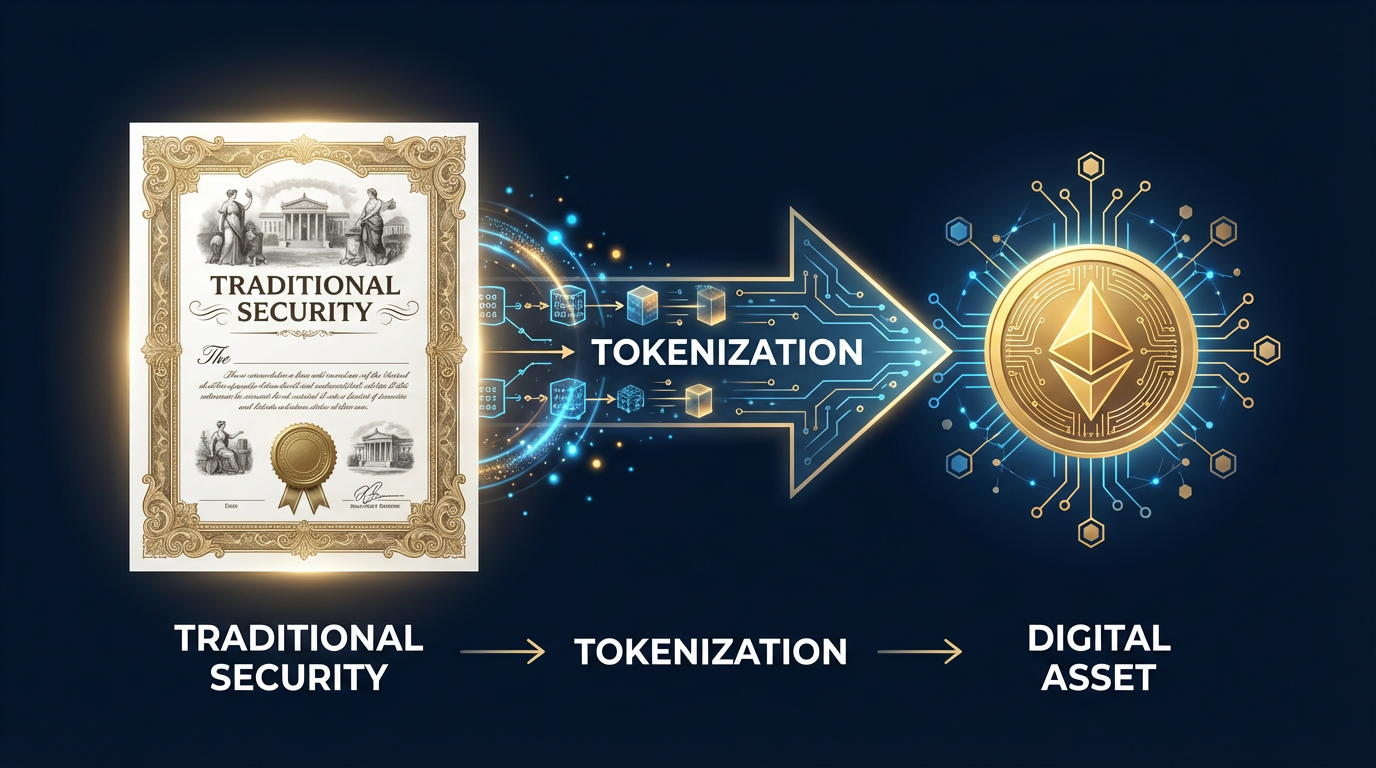
The regulatory progress is occurring against the backdrop of explosive growth in the global market for tokenizing real-world assets. This market grew from approximately $5 billion in 2022 to nearly $24 billion by mid-2025—a nearly fivefold increase in three years.
The growth is being driven by institutional adoption at scale. BlackRock, Franklin Templeton, and Goldman Sachs are actively issuing and integrating tokenized assets, particularly U.S. Treasuries and money market funds. Tokenized Treasury and money market fund assets alone reached $7.4 billion in 2025. Private credit has become the largest segment of the RWA market, accounting for over 60% of tokenized assets.
Future projections are immense. McKinsey estimates the market could reach $2 trillion to $4 trillion by 2030. Boston Consulting Group has projected a $16 trillion opportunity by the same date. Standard Chartered anticipates a potential $30 trillion market by 2034.
These are not speculative projections. They are the logical extrapolation of a trend that is already well underway, now accelerated by the regulatory clarity that the SEC’s recent actions have provided.
What This Means for Tokenized Fund Structures
For investment funds that have already embraced tokenization—like Savanti Investments, which issues its fund LP interests as ERC-20 digital securities on the Polygon blockchain—the SEC’s recent actions are validating and enabling.
The January taxonomy confirms that issuer-sponsored tokenized fund interests are securities subject to existing federal securities laws, including registration requirements or applicable exemptions. For funds operating under SEC Regulation D, Rule 506(c)—which allows general solicitation to accredited investors—the regulatory framework remains intact and is now better defined.
More importantly, the Nasdaq approval and the DTC pilot establish a precedent and a potential future trading venue for tokenized fund interests. The ability to trade tokenized securities on a regulated exchange, with DTC clearing and settlement, is precisely the infrastructure that could eventually enable secondary market liquidity for tokenized private fund interests—a capability that has historically been one of the most significant limitations of private fund investing.
Savanti’s tokenization infrastructure was designed with this future in mind: ERC-20 tokens on Polygon, SEC-compliant digital securities, and 24/7 secondary market access on a regulated ATS exchange. The regulatory environment is now beginning to reflect the architecture we built.
For accredited investors interested in understanding how tokenized fund structures work in practice, we invite you to explore our investor resources or contact our team directly.
The Thought Leader’s Perspective
The significance of the SEC’s March 18 approval extends beyond its immediate operational scope. It is a signal—to markets, to institutions, and to the global financial system—that the United States is committed to leading the tokenization of capital markets rather than ceding that ground to other jurisdictions.
The European Union has been advancing its Markets in Crypto-Assets (MiCA) regulation. Singapore and Hong Kong have been aggressively courting digital asset innovation. The SEC’s actions represent a deliberate choice to build a regulatory framework that enables U.S. capital markets to remain the global standard.
For institutional investors, the message is equally clear: the question is no longer whether to engage with tokenized securities, but how to do so within a well-defined regulatory framework. The infrastructure is being built. The rules are being written. The moment to understand this transition—and to position accordingly—is now.
Risk Disclosure: Investing in private investment funds involves substantial risks, including the risk of complete loss of capital, illiquidity, use of leverage, and complex tax consequences. Past performance—whether actual, simulated, or backtested—is not indicative of future results. The information in this article is for informational purposes only and does not constitute investment advice. Fund interests are offered only to U.S. accredited investors under SEC Regulation D, Rule 506(c). Tokenized securities trade on ARQ Securities’ ATS exchange (SEC-regulated), but they are unregistered offerings. Please review all offering documents carefully and consult with qualified legal, financial, and tax advisors before investing.