DISCLAIMER: This article is for educational and informational purposes only and does not constitute investment advice, a recommendation, or an offer to buy or sell any securities. Past performance is not indicative of future results. All investments involve risk, including possible loss of principal.
Building institutional-grade blockchain infrastructure requires examining five interconnected layers: consensus and settlement, custody and key management, compliance and governance, interoperability, and operational resilience. This technical deep-dive breaks down each component to help sophisticated institutions evaluate and implement blockchain solutions with enterprise rigor.
Executive Summary
Blockchain technology has matured from experimental protocol to enterprise infrastructure. For institutional adoption, success depends on architecting systems that meet traditional finance standards for security, compliance, and operational reliability while leveraging blockchain’s unique capabilities. This guide provides the technical framework for evaluation and implementation.
Layer 1: Consensus and Settlement Infrastructure
Network Selection Criteria
Institutional blockchain deployment begins with network selection. Key evaluation factors include:
| Criterion | Considerations | Institutional Priority |
|---|---|---|
| Throughput | Transactions per second capacity | Must exceed operational requirements with headroom |
| Finality | Time to irreversible settlement | Sub-minute for most use cases |
| Decentralization | Node distribution and governance | Balance security with operational needs |
| Regulatory Clarity | Jurisdictional treatment | Essential for compliance planning |
| Ecosystem Maturity | Developer tools, integrations | Reduces implementation risk |
Layer-2 Solutions
Layer-2 scaling solutions—rollups, state channels, sidechains—enable institutional throughput requirements while inheriting Layer-1 security guarantees. Zero-knowledge rollups, in particular, offer compelling combinations of scalability and privacy.
Layer 2: Custody and Key Management
Custody Architecture Options
Self-Custody: Institution maintains direct control of private keys. Maximum control; requires significant security infrastructure investment.
Qualified Custodian: Regulated third-party custodian holds assets. Meets regulatory requirements for certain investor types; introduces counterparty dependency.
Multi-Party Computation (MPC): Key shares distributed across multiple parties. Eliminates single points of failure; requires sophisticated implementation.
Security Standards
- Hardware Security Modules (HSMs): Tamper-resistant cryptographic processors for key storage
- Multi-Signature Requirements: Multiple approvals required for transactions
- Geographic Distribution: Key shares stored across secure facilities
- Disaster Recovery: Tested backup and recovery procedures
Layer 3: Compliance and Governance
Programmable Compliance
Smart contracts enable compliance rules embedded directly in transaction logic:
- Transfer Restrictions: Automated enforcement of holding periods, accreditation requirements
- KYC/AML Integration: On-chain verification of identity attestations
- Regulatory Reporting: Automated generation of required disclosures
- Sanctions Screening: Real-time transaction monitoring against watchlists
Governance Frameworks
Institutional blockchain implementations require clear governance covering:
- Smart contract upgrade procedures
- Incident response protocols
- Stakeholder communication requirements
- Audit and attestation schedules
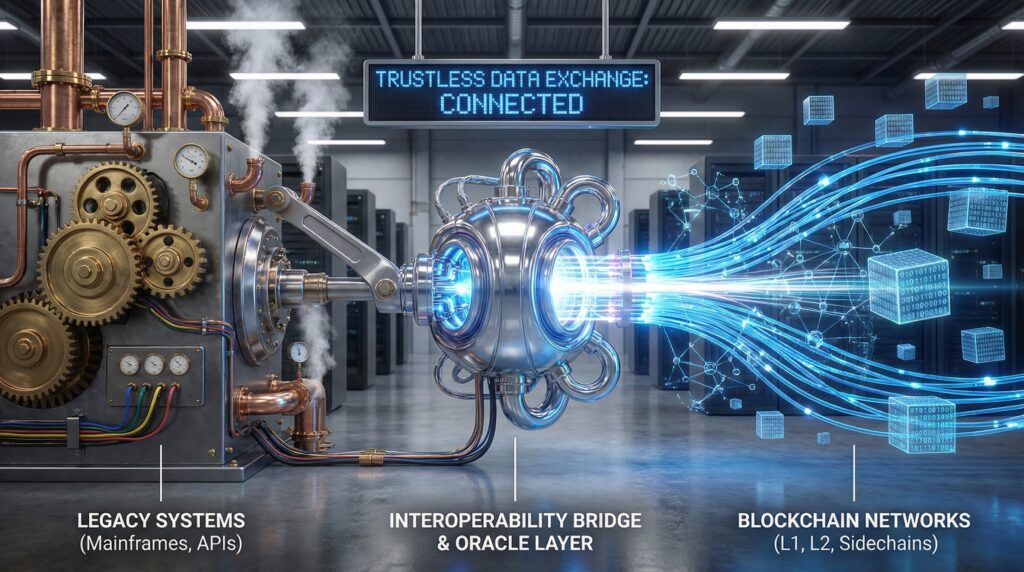
Layer 4: Interoperability
Cross-Chain Communication
Enterprise blockchain often requires interaction across multiple networks:
Bridge Protocols: Asset transfer between chains. Security considerations critical—bridge exploits have caused significant losses.
Messaging Layers: Cross-chain data communication without asset transfer. Lower risk profile than bridges.
Atomic Swaps: Trustless exchange of assets across chains. Limited to compatible cryptographic implementations.
Traditional System Integration
Connecting blockchain infrastructure to existing systems requires:
- API Layers: RESTful interfaces for application integration
- Oracle Networks: Secure external data feeds
- Middleware Solutions: Data transformation and routing
- Legacy Connectors: Integration with existing custody, accounting, reporting systems
Layer 5: Operational Resilience
Monitoring and Observability
- Transaction Monitoring: Real-time visibility into on-chain activity
- Node Health: Infrastructure performance tracking
- Anomaly Detection: Automated alerting for unusual patterns
- Audit Trails: Comprehensive logging for compliance review
Disaster Recovery
Enterprise blockchain requires robust continuity planning:
- Geographic redundancy for critical infrastructure
- Regular backup testing and recovery drills
- Documented failover procedures
- Business continuity integration with broader enterprise DR
The Savanti Implementation
At Savanti Investments, our blockchain infrastructure incorporates these institutional-grade principles:
- Regulated ATS Settlement: Tokenized fund interests settle on Liquidity.io’s compliant infrastructure
- Enterprise Custody: Institutional-grade custody solutions meeting qualified custodian standards
- Programmable Compliance: Transfer restrictions and investor verification embedded in smart contracts
- 24/7 Operations: Infrastructure supporting continuous trading of tokenized fund interests
Our QuantAI™ and SavantTrade™ systems integrate with this infrastructure, enabling systematic global macro strategies through blockchain-native settlement.
Implementation Roadmap
For institutions evaluating blockchain adoption:
- Use Case Definition: Clearly articulate what problems blockchain solves for your specific operations
- Regulatory Assessment: Engage legal counsel on jurisdictional requirements
- Vendor Evaluation: Assess infrastructure providers against institutional requirements
- Pilot Implementation: Start with limited scope to validate assumptions
- Production Scaling: Expand based on pilot learnings
Conclusion
Institutional blockchain infrastructure is no longer experimental—it’s enterprise-ready for organizations willing to implement with appropriate rigor. The framework outlined here provides the technical foundation for evaluation and deployment.
Success requires treating blockchain as infrastructure deserving the same engineering discipline applied to any enterprise system. The technology’s unique properties—immutability, transparency, programmability—offer genuine value, but only when implemented within robust operational frameworks.
Important Disclosures
This content is provided by Savanti Investments for informational purposes only and does not constitute an offer to sell, a solicitation of an offer to buy, or a recommendation for any security or investment strategy.
Savanti Investments operates through Savanti, LLC (fund general partner) and Savanti Asset Management, LLC (state-level exempt investment advisor). Neither entity is registered with the SEC as an investment adviser or broker-dealer.
Investment in hedge funds and alternative investments is speculative, involves a high degree of risk, and is suitable only for sophisticated investors who can bear the loss of their entire investment. Tokenized securities involve additional risks related to blockchain technology, regulatory uncertainty, and market liquidity.
For complete risk disclosures and fund documentation, qualified investors may contact investor relations at https://savanti.investments
© 2026 Savanti Investments, Inc. All rights reserved.