
Compliance Disclaimer: This article is for informational and educational purposes only. It does not constitute an offer to sell or a solicitation of an offer to buy any securities or investment products. This content is intended solely for accredited investors as defined under SEC Rule 501 of Regulation A. Savanti Investments operates under SEC Regulation D, Rule 506(c). No performance claims are made herein. Past results are not indicative of future performance. All investment decisions should be made in consultation with qualified financial, legal, and tax advisors.
Overview
On March 17, 2026, SEC Chairman Paul S. Atkins delivered a landmark speech outlining a comprehensive framework for digital asset regulation — including a proposed “Token Safe Harbor” that could fundamentally reshape how digital securities are issued, traded, and governed in the United States. This technical analysis examines the mechanics of the proposed framework, its implications for Reg D 506(c) tokenized fund structures, and what digital securities issuers need to understand to navigate the new compliance landscape.
The Token Safe Harbor: Structural Components
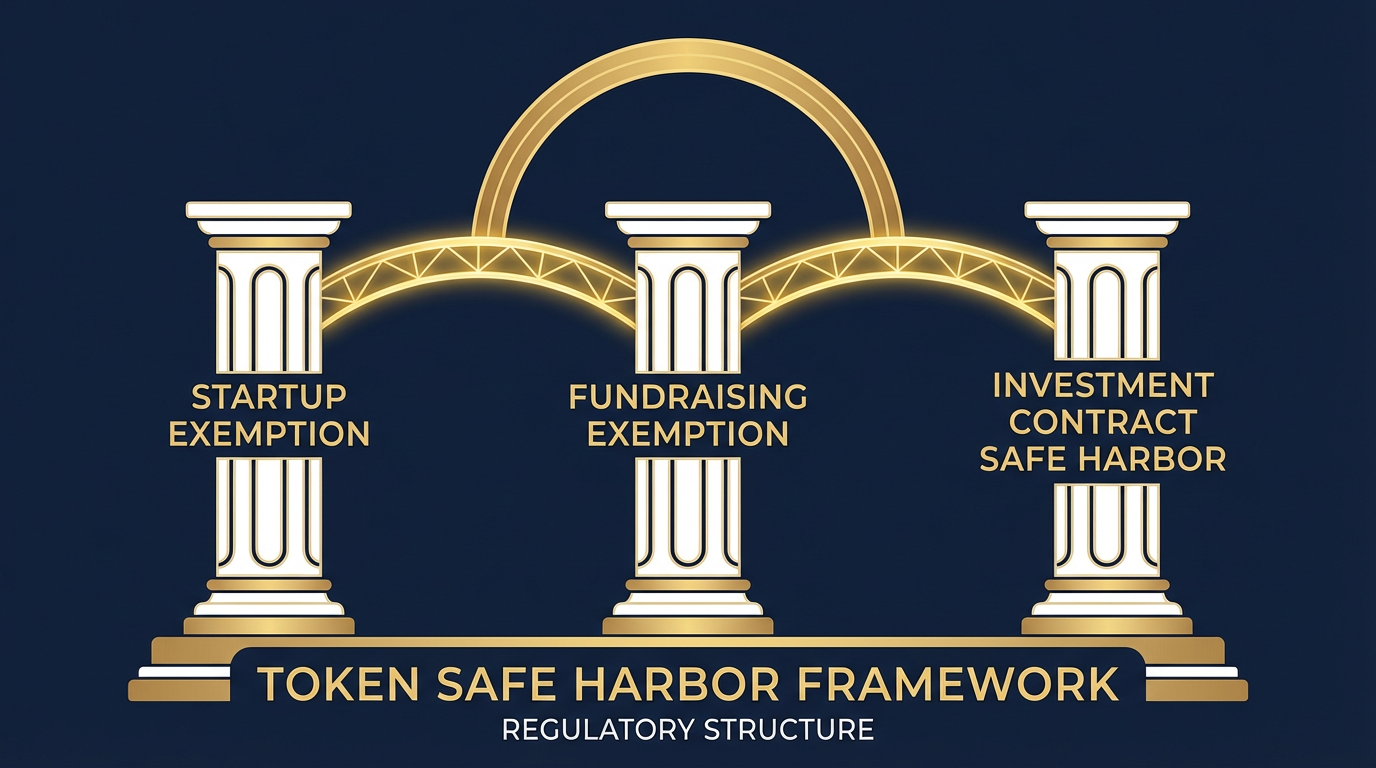
The Token Safe Harbor framework proposed by Chairman Atkins consists of three distinct but interrelated components, each addressing a different phase of a digital asset’s lifecycle.
Component 1: The Startup Exemption
The Startup Exemption provides a time-limited registration exemption for offerings of investment contracts involving certain crypto assets. Key parameters:
- Duration: Up to four years from the date of first token sale
- Fundraising cap: Up to $5 million in aggregate
- Disclosure requirements: Principles-based rather than prescriptive — issuers must provide sufficient information for investors to make informed decisions, but are not required to file full registration statements
- Investor eligibility: The exemption does not restrict offerings to accredited investors, though issuers may choose to limit participation
The four-year runway is designed to give development teams sufficient time to build functional networks before their tokens are evaluated under the full Howey test framework. This addresses a fundamental tension in the prior regulatory environment: tokens sold to fund development were often deemed securities at issuance, but the regulatory treatment did not account for the possibility that the network might later become sufficiently decentralized to remove the “efforts of others” prong of Howey.
Component 2: The Fundraising Exemption
For more mature projects seeking larger capital raises, the Fundraising Exemption provides:
- Fundraising cap: Up to $75 million within any 12-month period
- Disclosure requirements: More structured than the Startup Exemption, including specific disclosures about token economics, use of proceeds, and governance mechanisms
- Investor eligibility: Likely to be limited to accredited investors given the scale of the offering
- Ongoing reporting: Issuers utilizing this exemption will be subject to ongoing disclosure obligations
The $75 million cap positions this exemption between Regulation A+ (maximum $75 million) and full registration, creating a new tier in the capital formation hierarchy specifically designed for digital asset issuers.
Component 3: The Investment Contract Safe Harbor
The most technically significant component is the Investment Contract Safe Harbor — a rule-based standard for determining when a crypto asset is no longer subject to federal securities laws.
Under this framework, a token sheds its investment contract status when:
- The issuer has completed all essential managerial efforts represented under the investment contract, OR
- The issuer has permanently ceased all such efforts
This is a codification and extension of the Howey test’s fourth prong — the “efforts of others” element. Once a network is sufficiently decentralized that token value is no longer dependent on the issuer’s ongoing managerial efforts, the token can transition from a security to a non-security digital commodity.
The practical implication is significant: issuers can now plan for a regulatory transition from security to commodity status, enabling secondary market trading on commodity exchanges without the full burden of securities law compliance.
The Five-Part Token Taxonomy: Technical Classification
The March 17 announcements established a definitive classification framework for crypto assets. Understanding the technical criteria for each category is essential for compliance planning.
Digital Commodities
Classification criteria: Value derived from the automated mechanics of a functional, decentralized blockchain network and market supply-and-demand dynamics — not from the managerial efforts of a central party.
Key technical indicators:
– Proof-of-Work or sufficiently decentralized Proof-of-Stake consensus
– No central party with ongoing obligations to token holders
– Network functionality independent of any single entity’s continued involvement
Regulatory treatment: CFTC jurisdiction for secondary market trading; not subject to SEC registration requirements.
Examples: Bitcoin (BTC), Ethereum (ETH), XRP, Solana (SOL)
Digital Collectibles
Classification criteria: Non-fungible tokens representing items whose value is driven by collectibility, aesthetic appeal, or personal enjoyment — not by profit expectations from managerial efforts.
Key technical indicators:
– Non-fungible (ERC-721 or similar standard)
– Value derived from the specific item’s characteristics, not from a pooled enterprise
– No financialization mechanics (fractionalization, yield generation) that would create profit expectations
Regulatory treatment: Generally not securities; may be subject to consumer protection regulations.
Compliance note: The guidance specifically flags that fractionalization of NFTs could create securities law implications if the fractionalized interests are marketed with profit expectations.
Digital Tools
Classification criteria: Tokens that provide a practical utility function — membership access, computational resources, governance rights, or credentials — acquired for their utility rather than as a financial investment.
Key technical indicators:
– Clear utility function that is operational at the time of sale
– Purchasers acquire the token for its utility, not primarily for profit
– No explicit or implicit promises of returns from managerial efforts
Regulatory treatment: Generally not securities; may be subject to consumer protection or commodity regulations depending on structure.
Payment Stablecoins
Classification criteria: Stablecoins issued under the GENIUS Act by “permitted payment stablecoin issuers” that do not pay interest and are fully backed by low-risk liquid reserves, redeemable 1:1 for U.S. dollars.
Key technical indicators:
– Full reserve backing with liquid, low-risk assets
– No interest payments to holders
– Redemption mechanism at par value
– Issued by a GENIUS Act-compliant entity
Regulatory treatment: Not securities or commodities; subject to GENIUS Act payment stablecoin framework.
Digital Securities
Classification criteria: Traditional financial instruments — stocks, bonds, fund interests, structured products — that are formatted or represented as crypto assets, with ownership records maintained on a blockchain or DLT.
Key technical indicators:
– Underlying instrument meets the definition of a “security” under federal securities laws
– Blockchain representation does not alter the legal rights conferred
– Ownership records maintained on-chain (issuer-sponsored) or through custodial/synthetic structures (third-party-sponsored)
Regulatory treatment: Full application of federal securities laws; SEC jurisdiction; registration or exemption required.
Compliance framework: Reg D 506(c) for private placements to verified accredited investors; Reg A+ for public offerings up to $75M; full registration for larger public offerings.

Implications for Reg D 506(c) Tokenized Fund Structures
For tokenized fund structures operating under Reg D 506(c) — the exemption that permits general solicitation to verified accredited investors — the 2026 framework provides both clarity and new compliance obligations.
What Changes
Positive developments:
– Clear classification of ERC-20 tokenized fund interests as “digital securities” removes ambiguity about regulatory treatment
– The SEC-CFTC MOU reduces the risk of duplicative enforcement actions for funds that also hold digital commodity positions
– The DTC tokenization pilot creates a pathway for tokenized fund interests to eventually integrate with traditional settlement infrastructure
New compliance considerations:
– Issuers must ensure their tokenization structure (issuer-sponsored vs. third-party-sponsored) is clearly documented and disclosed to investors
– UCC Article 8 (investment securities) or Article 12 (controllable electronic records) compliance must be explicitly addressed in offering documents
– Secondary market trading on ATS platforms must comply with the SEC’s guidance on tokenized security entitlements
The ATS Exchange Framework
For tTokenized Fund Interests trading on Alternative Trading Systems (ATS), the 2026 framework clarifies that:
- The ATS must be registered with the SEC as a broker-dealer and operate under Regulation ATS
- Trading of tokenized fund interests on the ATS constitutes trading in securities, subject to all applicable securities laws
- Investors’ token holdings represent security entitlements, with rights against the ATS’s custodial infrastructure
At Savanti Investments, our fund interests are issued as ERC-20 and ERC-3643 digital securities built on the gold standard Ethereum Blockchain and listed on US-regulated ATS exchange, Liquidity.io. This structure — issuer-sponsored tokenization with ATS secondary market trading — aligns precisely with the SEC’s preferred compliance framework for tokenized fund interests.
For accredited investors seeking to understand how this structure works in practice, our Investment Funds page provides detailed information on our tokenization architecture and investor rights.
The SEC-CFTC MOU: Jurisdictional Mechanics
The March 11, 2026 MOU between the SEC and CFTC establishes a formal coordination framework with specific operational implications for digital asset market participants.
Joint Harmonization Initiative
The Joint Harmonization Initiative, co-led by senior staff from both agencies, will coordinate across six core areas:
- Product definitions: Establishing clear criteria for classifying assets as securities vs. commodities
- Clearing and margin: Modernizing frameworks for digital asset clearing and collateral
- Regulatory reporting: Streamlining reporting obligations for dually regulated entities
- Enforcement coordination: Preventing duplicative enforcement actions
- International coordination: Aligning US frameworks with international regulatory developments
- Innovation facilitation: Creating regulatory sandboxes for novel digital asset structures
Practical Implications for Fund Managers
For fund managers operating in both digital securities and digital commodities — as many systematic macro funds do — the MOU creates a more predictable regulatory environment. Funds can now structure their digital asset exposure with greater confidence about which regulatory framework applies to each position.
Compliance Roadmap for Digital Securities Issuers
Based on the 2026 framework, digital securities issuers should prioritize the following compliance actions:
Immediate priorities:
– Classify all existing and planned token offerings under the five-part taxonomy
– Document the tokenization structure (issuer-sponsored vs. third-party-sponsored) in offering materials
– Review UCC Article 8/12 compliance for existing tokenized security structures
– Assess whether any existing tokens may qualify for the Investment Contract Safe Harbor
Medium-term priorities:
– Evaluate whether the Startup Exemption or Fundraising Exemption is appropriate for planned token offerings
– Engage with the SEC’s Division of Corporation Finance on any novel tokenization structures
– Monitor the DTC tokenization pilot for integration opportunities with traditional settlement infrastructure
Ongoing obligations:
– Maintain compliance with Reg D 506(c) verification requirements for accredited investor status
– Ensure ATS trading of tokenized fund interests complies with Regulation ATS
– Monitor SEC-CFTC Joint Harmonization Initiative developments for new guidance
To discuss how these compliance considerations apply to your investment evaluation, schedule a consultation with the Savanti Investments team. Our Disclosures & Risk Factors page provides comprehensive information on our regulatory framework.
Conclusion
The SEC’s Token Safe Harbor proposal and the broader 2026 digital asset regulatory framework represent the most significant development in digital securities compliance since the initial application of the Howey test to crypto assets. For digital securities issuers, the framework provides a clear compliance roadmap. For accredited investors, it provides the regulatory certainty needed to evaluate tokenized fund structures with confidence.
The technical details matter. The classification of a token, the structure of its tokenization, and the regulatory framework governing its secondary market trading all have direct implications for investor rights and risk exposure. Understanding these mechanics is not optional for sophisticated market participants — it is the foundation of informed investment decision-making in the digital securities era.
Risk Disclosure: Investing in tokenized securities and alternative investment funds involves significant risks, including the potential loss of principal. Digital securities are subject to unique risks including technological vulnerabilities, regulatory changes, smart contract risks, and liquidity constraints. This content is for informational and educational purposes only and does not constitute investment advice or legal counsel. Past performance is not indicative of future results. Accredited investors should review all offering documents, consult with qualified legal, financial, and tax advisors, and carefully consider their investment objectives and risk tolerance before making any investment decisions. Savanti Investments operates under SEC Regulation D, Rule 506(c) and does not make performance guarantees.
Share this article:
